Sunrise over the Melaka River comes in slowly. Mist sits low over the water near Jalan Tun Sri Lanang before the first trishaw bells start up along Jonker Street, and the air still carries the coolness of the night, not yet thickened by the day’s humidity. Shopkeepers unlatch wooden shutters one by one. Somewhere behind a shophouse wall, someone is already stir-frying garlic. This is the hour before the tour buses arrive — and it’s the version of Melaka worth actually knowing.
Melaka earned its place on the UNESCO World Heritage List on 7 July 2008, inscribed jointly with George Town, Penang, under the listing “Historic Cities of the Straits of Malacca.” The recognition wasn’t for any single monument. It was for more than 500 years of continuous trade and cultural exchange, made possible by one simple accident of geography: Melaka sits at the narrowest, most sheltered point of the Strait of Malacca, the channel that funneled ships between China, India, the Middle East, and Europe for centuries. Whoever controlled this stretch of water controlled a hinge point of global trade — and the Malay Sultanate, then the Portuguese, then the Dutch, then the British, all took their turn.
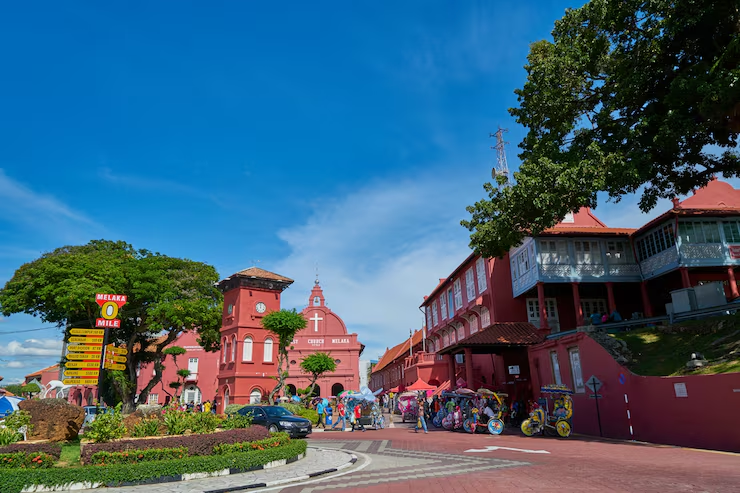
Most visitors treat that legacy as a checklist. Snap a photo at the red Dutch Square, eat one plate of chicken rice balls on Jonker Street, buy a fridge magnet, get back on the coach to Kuala Lumpur before dark. That approach sees maybe a tenth of what’s actually here. Exploring the historic streets of Melaka properly means slowing down enough to read a building instead of just photographing it — to notice a airwell, a Dutch gable, a century-old ancestral plaque above a doorway that most people walk straight past.
This guide is built as a walkable route through four defining streets of Melaka’s UNESCO core, with the specific historical detail, architecture, and local knowledge to make each one worth the extra time.
Jalan Tun Tan Cheng Lock (Heeren Street) — Millionaires’ Row
A Verified Historical Insight
Heeren Street’s story starts under Dutch rule, when it was laid out as Heerenstraat — “Gentlemen’s Street” — and served as an address for colonial administrators. But its real transformation happened in the mid-19th and early 20th centuries, when it became the residential address of choice for Melaka’s wealthiest Straits-born Chinese (Peranakan) families. These families made their fortunes as intermediaries in the tin, rubber, and spice trades, and they competed openly with one another to build the most ornate ancestral home on the street. It earned the nickname Millionaires’ Row, a name locals still use today. After independence, the street was renamed in honor of Tun Tan Cheng Lock, a fifth-generation Peranakan born here who went on to found the Malayan Chinese Association.
The Architectural Detail Worth Spotting
Look closely at the width of the shophouse facades along this street — they’re narrow, almost uniformly so, rarely more than a few meters across. This wasn’t an aesthetic choice. Under both Dutch and later colonial property tax systems, buildings were taxed according to their street frontage width, not their overall floor area. Wealthy families responded by building narrow-fronted, deep-interior houses, sometimes stretching 50 meters or more back from the street, layered with multiple internal courtyards known as airwells — open-to-sky spaces that pulled natural light and rain-cooled air deep into the building’s core, long before anyone had electric ventilation. Look above doorways too, where you’ll often spot small carved ancestral name plaques, quietly marking which family has occupied a particular house for generations.
The Local Secret
Number 8, Heeren Street, restored by Badan Warisan Malaysia, offers a rare look inside an original 18th-century shophouse structure without the added flourish of a museum gift shop experience — it’s kept close to how these homes genuinely functioned. Directly across from Hotel Puri stands the Chee Mansion, the single grandest surviving house on the street, built by Chee Swee Cheng, a founding figure of the old Overseas Chinese Banking Corporation. Its fairy-tale watchtower and Dutch-influenced detailing make it worth pausing at even from the street, since much of the interior remains a private residence.
Crowding & Timing Strategy
Heeren Street runs parallel to Jonker Street but carries a fraction of the foot traffic, which makes it walkable at almost any hour. The exception is around 10am to noon, when tour groups visiting the Baba & Nyonya Heritage Museum spill briefly onto the pavement between guided sessions. Arrive before 9:30am or after 1pm to have the architecture largely to yourself.
Jalan Hang Jebat (Jonker Street) — Beyond the Night Market
A Verified Historical Insight
Jonker Street’s fame today rests almost entirely on its Friday-to-Sunday night market, but that reputation obscures a much older function. During the Dutch and early British periods, this street operated as a working commercial and clan district — home to trade guilds, moneylenders, and kongsi (clan association houses) that organized Melaka’s Chinese immigrant communities by dialect group and ancestral origin. Several of these clan houses still stand today, quietly functioning behind unmarked doors, well away from the market stalls that define the street after dark.
The Architectural Detail Worth Spotting
By daylight, look up rather than at eye level. Many of Jonker Street’s older shophouses retain original decorative air vents carved directly above their doorways — ornamental ironwork or timber fretwork designed to let hot air escape before mechanical ventilation existed. Some buildings still show the ghost outline of a Chinese guild signboard bracket above the entrance, even where the guild itself has long since dissolved or relocated. Step into any open shopfront during the day and you’ll often see straight through to an internal courtyard, a design carried over from southern China and adapted here to Melaka’s tropical heat.
The Local Secret
Skip the souvenir stalls clustered near the main junctions and walk toward the quieter stretch closer to Jalan Tokong, where a handful of traditional trades persist: Chinese medicine halls with drawers of dried herbs stacked floor to ceiling, hand-carved signboard workshops, and antique dealers who’ve occupied the same shoplot since well before the night market existed.
Crowding & Timing Strategy
Weekend evenings, particularly after 7pm, turn Jonker Street into dense, slow-moving foot traffic focused almost entirely on the night market stalls. For genuine architectural viewing, a weekday morning between 9 and 11am is the better window — shutters are just opening, the street is walkable, and the daytime character of the buildings is far easier to appreciate without a crowd obscuring the shopfronts.
Jalan Tokong (Harmony Street) — Three Faiths, One Curved Road
A Verified Historical Insight
Locals call this street Harmony Street because within roughly 500 meters, it holds a functioning mosque, a Chinese temple, and a Hindu temple — a configuration that emerged organically from centuries of coexisting trade communities rather than any deliberate urban planning. The oldest of the three is Cheng Hoon Teng Temple, generally dated to 1645 under the Chinese Kapitan Tay Kie Ki during the Dutch Malacca era, with major structural additions completed in 1673 using materials shipped directly from China. It’s widely recognized as Malaysia’s oldest continuously operating Chinese temple, dedicated primarily to Kuan Yin, the Goddess of Mercy, and built around the “Three Teachings” of Buddhism, Taoism, and Confucianism. A short walk away, Kampung Kling Mosque dates to 1748 as a wooden structure, rebuilt in brick in 1872, while Sri Poyyatha Moorthi Temple, one of Malaysia’s few remaining Chitty temples, has stood since 1781, dedicated to Ganesha.
The Architectural Detail Worth Spotting
At Kampung Kling Mosque, study the roofline before anything else: a triple-tiered green pyramid roof, closer in form to a Hindu meru or Chinese pagoda than to a conventional dome, paired with a minaret that echoes the same pagoda silhouette. That blend of Sumatran, Chinese, Hindu, and Malay architectural language is entirely intentional — a direct physical record of the trading communities that built this street together. At Cheng Hoon Teng Temple, look for the ceramic shard-work decorating the roof ridges, a southern Chinese technique using broken porcelain fragments pressed into intricate figures and floral motifs, along with gold-gilded beams inside the main prayer hall.
The Local Secret
Several unassuming kopitiams cluster near the mosque end of the street, serving strong kopi-O and kaya toast with no English signage and no tourist-facing menu — the kind of place that’s been feeding the neighborhood’s older generation for decades and is worth choosing over the more polished cafes near Jonker Street.
Crowding & Timing Strategy
Because Harmony Street sits slightly off the main tourist spine, it rarely gets genuinely crowded — but active prayer times at both the mosque and the temples deserve extra sensitivity. Visiting late morning on a weekday, outside of Friday prayer hours, gives the calmest, most respectful window to appreciate all three sites without disrupting worship.
Lorong Jambatan & The Melaka River Alleys
A Verified Historical Insight
Long before any road mattered here, the Melaka River was the reason this city existed at all. Ships anchored where the river met the Strait, and goods — spices, textiles, porcelain, and more — were ferried inland along narrow waterside lanes like Lorong Jambatan (“Bridge Lane”), which connected the old warehouse district to the main trading streets above. These alleys formed the working, unglamorous backbone of Melaka’s spice trade for centuries, well before the riverside was ever reimagined as a tourist promenade.
The Architectural Detail Worth Spotting
Look for the old warehouse buildings that still back directly onto the river. Many retain their original loading doors and pulley hooks near roofline height, a legacy of an era when goods were hoisted straight up from boats moored below. In recent years, the riverside has also become home to a genuinely thoughtful street art scene, with murals painted directly onto weathered brick that reference the area’s trading and Peranakan history rather than generic decoration — look for pieces depicting trishaws, spice traders, and traditional Baba Nyonya motifs woven into the artwork itself.
The Local Secret
Skip the riverside cafes charging a premium for river views, and step one lane back instead, where plainer, family-run kopitiams still serve the neighborhood at local prices. For cendol away from the crowds photographing the version on Jonker Street, the stalls near Jalan Laksamana are worth the short walk in the late afternoon, shaving ice to order rather than serving it pre-prepared.
Crowding & Timing Strategy
The river walkway is at its most atmospheric after dark, when the old shophouses along the water are lit up — but that’s also when foot traffic peaks, roughly 6 to 9pm. For a quieter experience and better photography light on the old brick, a late-morning visit works best, well ahead of the evening crowds.
Actionable Explorer Logistics
Getting There and Around
- By car: Melaka’s historic core is compact but not built for driving — narrow one-way streets and heavy pedestrian traffic make a car more hindrance than help once you’re inside the heritage zone.
- Parking: The most practical option is parking at a paid car park just outside the core (near Dataran Pahlawan or along Jalan Merdeka) and walking in, rather than hunting for street parking within the UNESCO zone itself.
- On foot: Walking remains the only way to actually see the architectural detail this guide covers — the entire heritage core, from Heeren Street to the river, comfortably covers on foot within a few hours.
- Trishaws: Traditional, flower-decorated trishaws are a genuine Melaka institution, not just a tourist gimmick, and a short ride is worth experiencing once — but they’re better suited to covering ground between neighborhoods than to appreciating architectural detail, which rewards a slower pace on foot.
Responsible Tourism
- Kampung Kling Mosque, Cheng Hoon Teng Temple, and Sri Poyyatha Moorthi Temple are all active places of worship, not museum exhibits. Dress modestly, keep voices low, and avoid entering restricted prayer areas without invitation.
- Many buildings along Heeren Street remain private residences. Admire facades from the street rather than stepping into open doorways uninvited.
- Support businesses that are genuinely part of the neighborhood’s living heritage — family-run kopitiams, traditional craft shops, generational trades — over generic souvenir retail, since patronage is one of the most direct ways visitors help keep these streets functioning as real neighborhoods rather than open-air museums.
Why Preservation Matters More Than Postcards
Melaka survives the way it does because its buildings have been continuously inhabited, repaired, and passed down rather than emptied out and roped off. Every ancestral plaque still mounted above a doorway, every temple roofline blending three architectural traditions into one structure, every kopitiam still run by the same family that opened it decades ago — that’s preservation happening in real time, not something frozen behind glass.
Walking these streets slowly is what turns a checklist into an understanding: Melaka isn’t one historic site, it’s a five-century argument for what happens when different trading communities build a city together instead of apart. That argument is still being made today, one shophouse, one temple, one family business at a time — which is exactly why exploring the historic streets of Melaka rewards patience over speed.
Which street corner stopped you in your tracks? Share your favorite discovery in the comments, and for more deep-dive cultural itineraries across Malaysia, keep exploring MalaysiaWide.com.
Place Your Advert Here
Partner with us to promote your brand to high-intent audiences exploring destinations throughout Malaysia.
Get Started