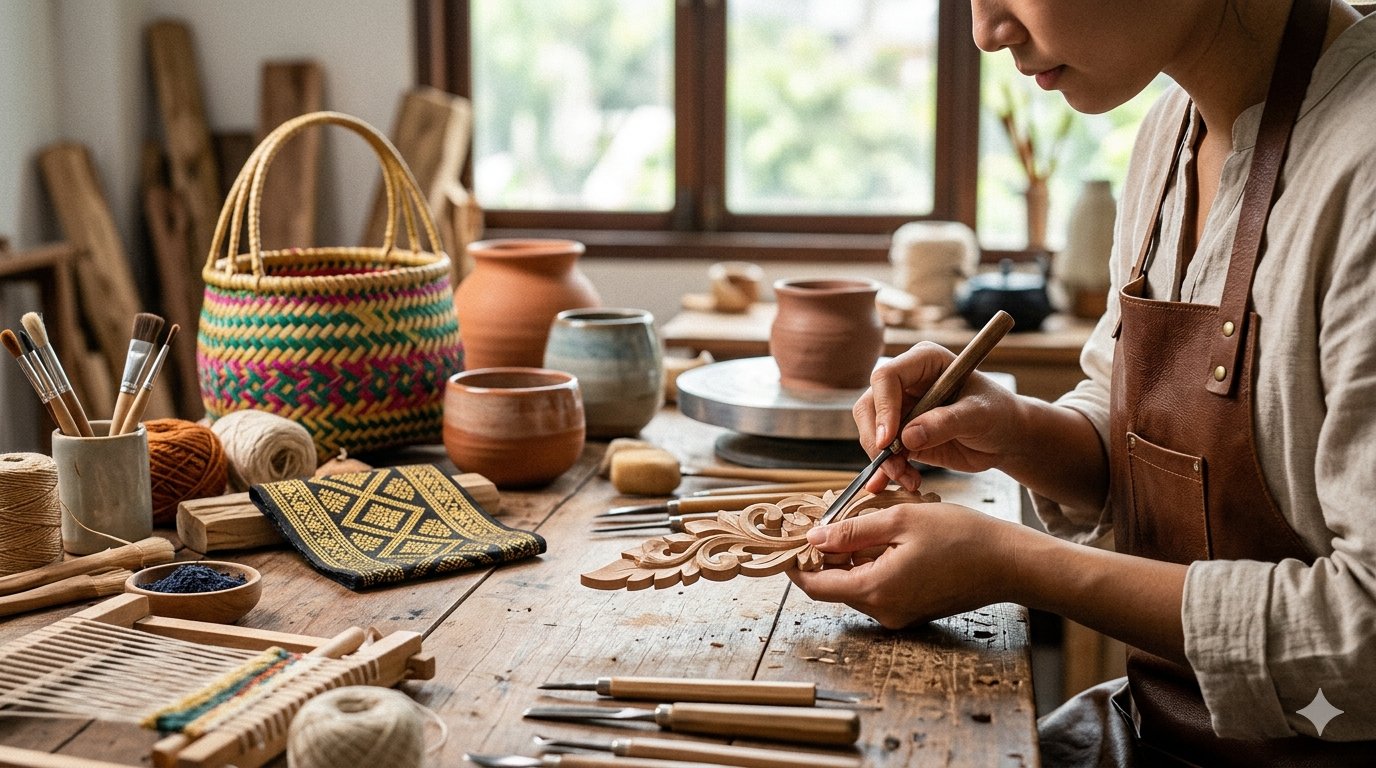
Malaysia’s traditional crafts have never completely disappeared. They have simply changed with the times.
Across the country, artisans, designers, artists and creative businesses are finding new ways to bring old techniques into contemporary life. Batik is appearing in modern clothing and lifestyle products. Songket is moving beyond ceremonial wear. Traditional pottery is being adapted as home décor, while weaving techniques are being used for bags, accessories and everyday objects.
That shift matters because handmade crafts depend on more than beautiful finished products. They depend on knowledge being passed from one generation to another.
Malaysia’s handicraft sector is supported by Kraftangan Malaysia, the Malaysian Handicraft Development Corporation, which recognises master craftsmen across areas including textiles, ceramics, wood, weaving and other traditional crafts. Its current list includes recognised practitioners in songket, Labu Sayong, wau, pandan and mengkuang weaving, wood carving, batik and several other disciplines.
The modern revival of Malaysian heritage crafts is therefore not simply about bringing back old designs. In many cases, it is about keeping traditional techniques relevant while allowing artisans and designers to experiment with new forms.
Here are seven Malaysian heritage crafts that are finding fresh relevance today.
1. Batik
Batik is perhaps the most recognisable Malaysian textile craft, and it is also one of the clearest examples of tradition adapting to modern tastes.
Traditional Malaysian batik involves applying wax and dye to fabric to create patterns. Different techniques, including hand-drawn batik and block printing, have produced distinctive styles across the country.
For many years, batik was strongly associated with traditional clothing. Today, its use is much broader.
Batik can be found on shirts, dresses, scarves, bags, accessories and home furnishings. Tourism Malaysia also lists contemporary batik products ranging from clothing and pareos to purses, cushion covers, placemats and tablecloths.
The modernisation of batik is also being encouraged at the state level. In 2026, Selangor organised the Selangor Craft Competition with the theme “Heritage. Identity. Innovation”, specifically encouraging new designs and product innovation while retaining traditional batik craftsmanship.
Young designers are also treating batik as a creative medium rather than simply a traditional textile. In 2026, a fashion design student presented a collection made entirely using the traditional batik canting technique at an international fashion event in Surabaya, using the craft to explore storytelling and contemporary fashion.
That combination of old technique and new application could be one of the reasons batik continues to find younger audiences.
2. Songket
Songket is another Malaysian textile with a long connection to ceremony, status and craftsmanship.
The fabric is traditionally handwoven with decorative metallic threads, producing intricate patterns that can take considerable skill and time to create. Tourism Malaysia describes Malaysian songket as a handwoven textile traditionally associated with royalty and ceremonial clothing.
But modern designers are increasingly asking a simple question: what happens when songket leaves the traditional wardrobe?
The answer can be seen in contemporary fashion, accessories, interiors and art.
Kraftangan Malaysia’s records show that songket artisans continue to work with both traditional and contemporary motifs. Master craftsman Wan Manang Wan Awang of Terengganu, for example, is recognised for producing traditional and contemporary songket patterns using techniques including coban and ikat.
Songket is also influencing artists outside textile production. In 2026, Malaysian artist Faizal Sidik presented an exhibition translating geometric songket motifs into paintings, wood sculptures and steel works. His approach demonstrates how patterns developed for traditional weaving can become a source of contemporary visual art.
Fashion has provided another route back into the mainstream. At Kuala Lumpur Fashion Week 2025, designers presented songket using modern silhouettes, explicitly positioning the traditional textile within contemporary fashion.
The craft is changing in appearance, but the underlying weaving knowledge remains important.
3. Labu Sayong and Traditional Pottery
The distinctive black, gourd-shaped Labu Sayong is closely associated with Kuala Kangsar in Perak.
Traditionally, the vessel was used as a water container. Its characteristic shape and dark surface have made it one of Malaysia’s best-known forms of traditional pottery. Tourism Malaysia identifies Labu Sayong as a distinctive Perak ceramic traditionally used as a water receptacle.
Today, however, the craft does not have to remain a functional water vessel.
Labu Sayong can also be produced as decorative pottery, planters and other objects for contemporary interiors. Kraftangan Malaysia’s documentation of master potter Hawa Ngah Salam provides an especially useful example of this transition. She was recognised for traditional Labu Sayong production while also experimenting with materials, forms and decorative approaches to respond to changing consumer preferences.
The same documentation records how master craftspeople developed products beyond the classic vessel, including flower pots and other ceramic decorative pieces.
This is an important part of a craft revival. A traditional object does not necessarily need to be used exactly as it was generations ago. Its techniques, shape and visual identity can survive by finding a place in modern homes.
For visitors to Perak, buying locally produced pottery can therefore be more than purchasing a souvenir. It can also provide a connection to a craft tradition that continues to evolve.
4. Wau-Making
Few Malaysian crafts are as visually distinctive as the traditional wau, or kite.
The wau is particularly associated with Kelantan and other parts of the Malay Peninsula, with different forms featuring distinctive shapes, decorations and patterns.
Traditional wau-making requires more than simply attaching paper to a frame. The structure must be carefully balanced, while decorative cut-outs can produce elaborate symmetrical patterns.
Kraftangan Malaysia recognises traditional wau master craftspeople and documents several forms, including Wau Bulan, Wau Merak, Wau Puyuh and Wau Barat. Traditional decorative motifs include patterns such as Awan Larat, Lada Hitam and various leaf-inspired designs.
Wau has also developed beyond being something flown in open fields.
Traditional wau are now displayed as decorative pieces, used in cultural programmes and collected by hotels, museums, government departments and private organisations. Kraftangan Malaysia’s profile of master craftsman Shafie Jusoh also records demonstrations and international cultural presentations connected with the craft.
That gives wau a place in both traditional recreation and contemporary cultural tourism.
Its intricate patterns also make it particularly suitable for modern visual applications, from interior decoration to graphic design and cultural branding.
5. Pandan and Mengkuang Weaving
Long before synthetic bags became commonplace, communities across Malaysia were turning leaves and natural fibres into useful household objects.
Pandan and mengkuang weaving is one of the country’s enduring forms of traditional craft. Leaves are processed, dried and woven into products such as mats, baskets, boxes and bags.
The craft has a natural advantage in today’s market: woven products can be both practical and visually distinctive.
Tourism Malaysia highlights woven pandan products including bags, floor mats, table mats, trinket boxes and gift boxes, noting that many are now available in contemporary designs.
Kraftangan Malaysia also continues to recognise specialists in pandan and mengkuang weaving. Its master-craftsmen records include Hajah Kelsom Abdullah for pandan/mengkuang weaving and other recognised practitioners working with natural-fibre weaving.
The craft is also broadening geographically and culturally. Kraftangan Malaysia recognises Mah Meri weaving in Selangor, for example, while other records include bamboo, rattan and serdang weaving.
For modern consumers, woven craft can fit naturally into home décor, fashion accessories and sustainable-lifestyle products.
The result is a traditional technique that can remain useful without pretending that modern consumers live exactly as their grandparents did.
6. Malaysian Woodcarving
Woodcarving has a particularly strong presence in Malaysia’s traditional architecture, decorative arts and indigenous cultures.
Traditional woodcarving can be seen in architectural details, furniture, panels and decorative objects. Sabah and Sarawak have their own distinctive woodcarving traditions, while Malay woodcarving is also associated with detailed floral and geometric motifs.
Tourism Malaysia identifies woodcarvings from the Orang Asli communities as well as Sabah and Sarawak among Malaysia’s notable craft products.
The craft continues to be represented in the country’s formal handicraft sector. Kraftangan Malaysia’s current industry classification includes registered craft businesses working in wood, while its master-craftsmen records include recognised practitioners in fine woodcarving and wood sculpture.
Modern woodcarvers can work on smaller decorative objects, contemporary furniture, sculptures and interior pieces rather than only traditional architectural elements.
That makes woodcarving particularly relevant to the growing interest in handmade interiors and locally produced design.
It also provides an opportunity to preserve traditional motifs while allowing individual craftsmen to develop their own styles.
7. Pewter Craft
Pewter may not immediately come to mind when people think about Malaysian traditional crafts, but it has a significant place in the country’s craft history.
Malaysia’s pewter tradition developed alongside the country’s tin-mining history, particularly in the Klang Valley. Today, pewter products range from tableware and drinkware to decorative objects and gifts.
Tourism Malaysia lists pewterware among the country’s popular craft products, including tea and coffee sets, goblets, picture frames, clocks and vases.
The craft has also found a way to combine manufacturing, skilled handwork and tourism.
For example, the Royal Selangor Visitor Centre in Kuala Lumpur offers visitors an opportunity to see pewter production and participate in hands-on workshops. Tourism Malaysia describes the visitor experience as including demonstrations of casting, hammering and polishing, alongside a workshop where visitors can shape their own pewter dish.
This type of experience changes how people encounter traditional craft. Instead of seeing a finished object in a shop, visitors can see the making process and try part of it themselves.
That connection between craftsmanship and experience is becoming increasingly important for cultural tourism.
Why Malaysian Heritage Crafts Are Changing
The modern revival of Malaysian crafts is not simply about making traditional products look fashionable.
There is a practical reason for adapting.
Crafts survive when there are people willing to learn them, artisans able to earn a living from them and customers interested in buying the finished work.
That is why contemporary applications matter.
A batik maker who produces modern clothing can reach customers who might never buy traditional ceremonial attire. A potter who creates contemporary home décor can introduce Labu Sayong-inspired ceramics to a new market. A weaver producing modern bags can bring an old technique into everyday life.
The same principle applies to songket.
Recent Malaysian cultural and fashion projects have repeatedly shown how traditional motifs can be incorporated into contemporary environments. In 2026, for example, shopping centres used songket, tenun, batik and tekat motifs in modern festive installations, combining traditional visual elements with contemporary illustration and design.
This does not mean every traditional craft needs to be redesigned.
Some artisans will continue making objects according to established methods, and that continuity is valuable in its own right. The revival happens partly because there is room for both approaches: preserving traditional production while allowing new generations to experiment.
What the Future Could Look Like
Malaysia’s heritage crafts are unlikely to return to exactly the role they played decades ago. The more interesting development is that they do not necessarily have to.
Their future may be found in a mixture of traditional knowledge and modern applications.
Batik can become contemporary fashion. Songket can enter modern interiors and art. Labu Sayong can become decorative ceramics. Wau can become collectible design. Natural-fibre weaving can produce everyday accessories. Woodcarving can move into contemporary interiors. Pewter can combine craftsmanship with visitor experiences and modern product design.
The challenge is making sure that modernisation does not remove the people and knowledge behind the craft.
A traditional pattern printed by machine is not necessarily the same thing as supporting an artisan who has spent years learning how to create it by hand. For heritage crafts to remain genuinely alive, commercial success and cultural preservation need to develop alongside one another.
Kraftangan Malaysia’s continuing recognition of master craftsmen reflects this broader effort to document and preserve specialised knowledge. Its national master-craftsmen programme describes the recognised artisans as reference points for preserving, promoting and developing Malaysian craft traditions at national and international levels.
For Malaysians and visitors alike, one of the simplest ways to support this tradition is to learn what goes into the objects they buy.
Ask where a piece was made. Find out whether it was handmade. Learn about the technique and community behind it. When possible, buy directly from artisans, recognised craft businesses or reputable craft centres.
That turns a souvenir into something more meaningful: a small contribution to keeping a living tradition in use.
Final Thoughts
Malaysia’s heritage crafts are not frozen pieces of the past.
They are still being woven, painted, carved, shaped and designed by people who understand traditional techniques but also live in a modern economy.
The comeback of batik, songket, Labu Sayong, wau, natural-fibre weaving, woodcarving and pewter shows that heritage does not necessarily have to compete with modern life. In the right hands, the two can exist together.
The strongest future for Malaysian handicrafts may therefore not be about reproducing yesterday. It may be about giving traditional skills enough space to create something new today.
For more stories about Malaysian culture, lifestyle, travel, food and local traditions, explore Malaysiawide.com.
Place Your Advert Here
Partner with us to promote your brand to high-intent audiences exploring destinations throughout Malaysia.
Get Started