Somewhere between the third notification of the day and the fortieth browser tab, most of us stop noticing how loud modern life has gotten. It creeps in slowly — the pinging, the scrolling, the low hum of always being reachable — until the idea of silence starts to feel almost foreign.
Borneo has a way of resetting that. Step off a boat onto the banks of the Kinabatangan River, or walk beneath a rainforest canopy that’s been standing since before the last Ice Age, and the noise just falls away. What replaces it is something older and steadier: the rhythm of cicadas at dusk, the distant crash of a hornbill’s wings, mist curling low over brown river water at sunrise.
Sabah and Sarawak hold some of the last great tracts of ancient rainforest left on Earth — 130-million-year-old ecosystems, home to orangutans, pygmy elephants, clouded leopards, and more bird species than most countries can claim in total. This isn’t a place that needs manufactured adventure. It already has more wildlife, more mystery, and more raw beauty than most travelers know what to do with.
But not every lodge here treads lightly. Some genuinely protect what they’re built on — funding conservation research, running turtle rehabilitation programs, hiring almost entirely from surrounding indigenous communities. Others just borrow the language of sustainability for the brochure. This guide sticks to the former: real eco-lodges in Sabah and Sarawak where comfort and conservation aren’t in tension, they’re the same idea. Consider this your shortlist for a genuine Borneo nature escape — and proof that sustainable travel in Malaysia can be every bit as luxurious as it is meaningful.
Sukau Rainforest Lodge — Life on the Kinabatangan River
Location: Kinabatangan River, Sabah | Best for: river wildlife cruises, birdwatching, first-time Borneo visitors
The Atmosphere
Sukau sits on stilts above the floodplain of the Kinabatangan, Borneo’s longest river, built almost entirely from Bornean hardwood so the structure barely interrupts the forest around it. Wake up here and the first thing you notice is sound before sight — the low percussion of insects, the occasional splash of something large moving through water you can’t yet see. Step onto your balcony and the river’s right there, brown and slow-moving, close enough to touch.
The Wild Experience
Sukau built its reputation on river safaris, and it’s easy to see why. Guides take small groups out at dawn and dusk — the two windows when the Kinabatangan floodplain comes properly alive — gliding along the water in boats fitted with quiet electric motors instead of noisy outboard engines. Proboscis monkeys crash through the treeline overhead, pygmy elephants sometimes wade at the water’s edge, and orangutans move through the canopy if you’re patient and a little lucky. Back at the lodge, the 1,500-foot Hornbill Boardwalk lets you walk straight into the forest without ever touching the ground, ending at three raised viewing decks built specifically for spotting wildlife without disturbing it.
Green Credentials
Sukau was the first lodge in the Kinabatangan area built specifically on ecotourism principles, back in 1995, and it’s kept that commitment current ever since. The lodge runs entirely on harvested rainwater, is completely single-use-plastic free, and channels a conservation levy from every guest into the Kinabatangan Corridor of Life initiative — funding that’s gone toward planting thousands of trees, supplying clean water tanks to local families, and running the ongoing Kinabatangan Wildlife Corridor Rehabilitation Project. This isn’t a token gesture; it’s decades of consistent, measurable reinvestment into the river system the lodge depends on.
Inside Tip for the Traveler
Book the early-morning river cruise over the late-afternoon one if you have to choose. Mist still clings to the water at that hour, wildlife is more active before the day heats up, and the light through the canopy is extraordinary for photography. Pack a proper zoom lens — most of what you’ll see is across the water, not beside you.
Borneo Rainforest Lodge, Danum Valley — Sleeping Inside Ancient Forest
Location: Danum Valley Conservation Area, Sabah | Best for: deep-forest immersion, serious wildlife spotting, canopy walks
The Atmosphere
Danum Valley isn’t a park you visit — it’s a reserve you disappear into. The Borneo Rainforest Lodge sits inside 438 square kilometers of virgin lowland rainforest that’s never been logged, one of the last of its kind left in Borneo. Thirty chalets are scattered along the Segama River, designed around eco-sensitivity rather than extravagance, and the forest presses right up against the walkways connecting them. At night, with the generator running only on limited hours, the darkness out here is the real kind — total, and strangely comforting.
The Wild Experience
The 300-meter canopy walkway, suspended 26 meters above the forest floor, is the property’s signature experience — go at first light and you’ll likely catch gibbons swinging through the upper branches while mist still sits in the valley below. Night drives reveal a different Danum entirely: civets, slow lorises, and if you’re fortunate, the elusive clouded leopard caught briefly in a spotlight beam. By day, guided treks wind through some of the oldest trees on the property, and the Segama River offers a genuinely peaceful way to cool off — floating, swimming, or simply sitting at the water’s edge listening to the forest work.
Green Credentials
The lodge operates in direct partnership with the Danum Valley Field Centre, a globally respected rainforest research station established in 1986, and it’s the primary research site for the Danum Orangutan Research Project — an ongoing collaboration between Kyoto University’s Wildlife Research Centre and the Sabah Foundation studying orangutan ecology since 2010. Guests aren’t just passing through a pretty forest; their stay directly funds one of Southeast Asia’s most important ongoing conservation studies.
Inside Tip for the Traveler
Danum Valley is remote — expect either a short flight to Lahad Datu followed by a road transfer, or a longer overland journey. Budget the travel time into your itinerary rather than treating it as a quick add-on; this isn’t a place to rush, and the lodge’s all-inclusive packages (meals, guided walks, and transfers) make it easy to settle in without logistics eating into your trip.
Tabin Wildlife Resort — Where the Pygmy Elephants Roam
Location: Tabin Wildlife Reserve, eastern Sabah | Best for: night safaris, mud volcano wildlife viewing, elephant sightings
The Atmosphere
Tabin feels wilder and less polished than some of Borneo’s other lodges, in the best possible way. The resort sits inside a 122,500-hectare wildlife reserve — the largest in Sabah — originally established in 1984 specifically to protect the state’s vanishing megafauna. River lodges and hill lodges are spread through the property, simple and comfortable rather than lavish, built to put the reserve itself front and center.
The Wild Experience
This is prime territory for spotting the Bornean pygmy elephant, the world’s smallest elephant subspecies, alongside banteng (wild cattle found only in Southeast Asia) and, if the timing lines up, the reserve’s elusive population of Sumatran rhinoceros habitat. Tabin’s mineral-rich mud volcanoes are the standout feature — wildlife visits them regularly to top up on minerals, making the volcano trail one of the most reliable wildlife-viewing spots in the reserve. Nine marked trekking trails wind through the property, and 4WD night safaris after dark bring out civets, owls, and the occasional clouded leopard slipping through the headlights.
Green Credentials
Tabin was purpose-built as a conservation initiative rather than retrofitted into one — the entire reserve exists because of a 1984 government decision to protect Sabah’s disappearing wildlife before it was too late. All guided activities are structured to minimize environmental disturbance, and the reserve remains under the joint custodianship of the Sabah Wildlife Department and Sabah Forestry Department, keeping commercial tourism accountable to conservation authorities rather than the other way around.
Inside Tip for the Traveler
Visit during the dry season, roughly March through October, if trekking is your priority — trails firm up considerably and wildlife-watching gets easier. If you’re chasing lush, cinematic green instead, the wetter months deliver that in spades, just be ready for muddier trails and pack accordingly.
Gaya Island Resort — Marine Conservation Meets Island Luxury
Location: Tunku Abdul Rahman Marine Park, off Kota Kinabalu, Sabah | Best for: coral restoration, turtle rehabilitation, marine biology-led experiences
The Atmosphere
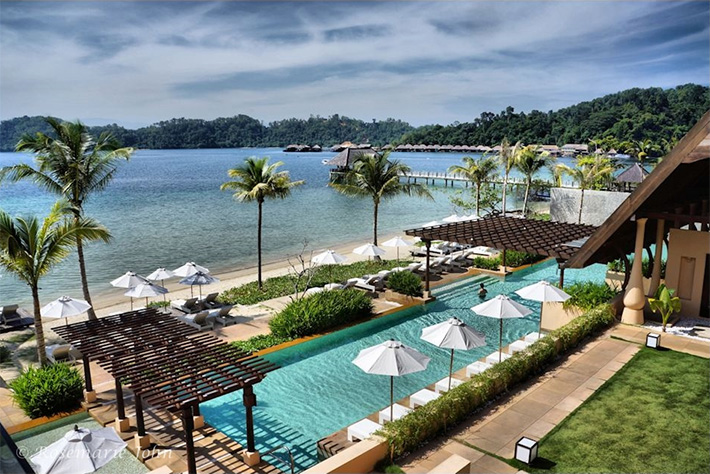
Gaya Island Resort sits within the Tunku Abdul Rahman Marine Park, on the edge of the Coral Triangle — one of the most biodiverse marine regions on the planet. The island itself is blanketed in rainforest estimated at over ten million years old, fringed by century-old mangroves, with the resort’s villas tucked along the shoreline of Malohom Bay. It’s the kind of setting where the ocean is never more than a few steps away, and the forest is always at your back.
The Wild Experience
The resort’s Marine Centre at Tavajun Bay, launched in 2013, is genuinely hands-on — guests can join coral planting sessions in partnership with the NGO Reef Check Malaysia, snorkel alongside a resident marine biologist, or observe the turtle rehabilitation program up close. The centre has cared for and released multiple endangered green sea turtles and at least one critically endangered hawksbill, each one nursed back to health over months or years before returning to open water. On land, guided rainforest walks with resort naturalists round out the experience, and the in-house Spa Village draws on traditional Bornean healing techniques using local herbs.
Green Credentials
Gaya’s Marine Centre operates around three defined conservation pillars — Turtle Rescue, Coral Reef Restoration, and Conservation through Education — backed by a resident marine biologist and a 14,000-litre recovery tank that doubles as a working coral nursery. The centre also trains local fishermen in less harmful fishing practices and runs a debris recycling program, extending its impact well beyond the resort’s own guests and into the surrounding fishing communities.
Inside Tip for the Traveler
Book the coral-planting session early in your stay rather than the last day — it tends to be the activity guests want to repeat once they’ve seen the nursery tanks and understood the process, and slots fill up fast in peak season.
Permai Rainforest Resort — Rainforest and Beach in One Address
Location: Foot of Mount Santubong, near Kuching, Sarawak | Best for: a mellow rainforest-meets-ocean stay, dolphin watching, family-friendly adventure
The Atmosphere
Permai is Sarawak’s answer to the question of what happens when rainforest and coastline share the same postcode. The resort sits at the base of Mount Santubong, bordered on two sides by protected forest and opening directly onto the beach on the third. Lodge houses and treehouses are scattered through the greenery rather than lined up in rows, and the sound of the South China Sea carries through the trees at night alongside the usual jungle chorus.
The Wild Experience
Mornings here mean hiking trails that climb into Santubong’s forested slopes; afternoons mean paddling out from the same stretch of beach. Boat cruises head out to spot Irrawaddy dolphins, an unusual, round-headed species found in Sarawak’s coastal waters, and evening firefly tours drift along the river as thousands of tiny lights flicker in the mangroves. A high ropes course and guided night jungle walks round things out for guests wanting a bit more adrenaline mixed into the calm.
Green Credentials
Permai was deliberately designed to minimize its footprint on the surrounding rainforest and coastline, and the resort has built a two-decade track record of steady, low-impact operation rather than one-off green initiatives. It’s also a significant source of local employment, drawing staff from surrounding communities and supporting the kind of sustainable, tourism-based livelihoods that keep pressure off the forest itself.
Inside Tip for the Traveler
Snorkel at Satang Island if you can fit in a day trip — it’s one of three islands the Sarawak government has specifically protected for turtle conservation, and it pairs naturally with the resort’s own low-impact ethos.
Before You Book: What Real Sustainability Looks Like
A resort calling itself “eco” doesn’t automatically mean much anymore — the label gets applied loosely across the travel industry. The properties above earn it the harder way: through rainwater systems that actually replace mains water, research partnerships that produce published science, conservation levies with public accounting, and staffing that genuinely centers local and indigenous communities rather than importing labor from elsewhere.
That distinction matters more in Borneo than almost anywhere else. This is one of the most biodiverse, and one of the most threatened, landscapes left on the planet — rainforest that’s taken millions of years to become what it is, and mere decades to lose in other parts of the island. Where you choose to stay becomes, in a small but real way, a vote for which version of Borneo survives.
A stay at any of these five places isn’t just a nature escape — it’s a stake in whether that nature is still here for the next traveler who needs to hear the forest instead of a notification.
Which one’s going on your list — the river silence of Sukau, the ancient stillness of Danum Valley, or the reef-and-rainforest combination at Gaya Island? Tell us in the comments, and keep exploring more Borneo travel itineraries and East Malaysia guides here on MalaysiaWide.com.
Place Your Advert Here
Partner with us to promote your brand to high-intent audiences exploring destinations throughout Malaysia.
Get Started